Cyre TEWA
Machine-speed weapon-target allocation across a distributed force, making explainable allocation decisions in under a second.
Integrated into Combat Management Systems within the Maritime Integration & Support Centre (MISC).
The Challenge
Modern fleets have their effectors distributed across a growing number of platforms, but the logic that decides which effector should engage which threat has largely stayed on board each individual platform. Every ship solves its own engagement problem in isolation, and when a raid arrives at scale the force can end up committing several effectors to the same threat while others go unengaged. Coordinating the response to threats using human communication methods is increasingly difficult within the time available, especially against modern massed threats. Handing it to a single central allocator brings problems of its own, since that allocator becomes both a bottleneck and something the force can ill afford to lose if communications are contested.
Our Solution
We built Cyre to resolve that allocation across the whole force, using predictive decentralised-first optimisation. Rather than solving one enormous fleet-wide problem, which becomes computationally explosive as platforms and effectors are added, Cyre treats the task group as a set of players. Each platform reasons locally over its own feasible effector-to-threat pairings, but scores them against a shared, fleet-wide measure of value: the kill probability achieved, weighted by how urgent each threat is, less the cost of expending scarce or unusually versatile resources. This decision making process is bound by the physical weapon constraints including firing arcs and rate of fire. Platforms then take turns responding to what the others currently intend, until none of them can improve the joint outcome by changing its own plan alone. What emerges is an engagement plan that is not simply good but self-consistent, and one that no platform has an incentive to depart from.
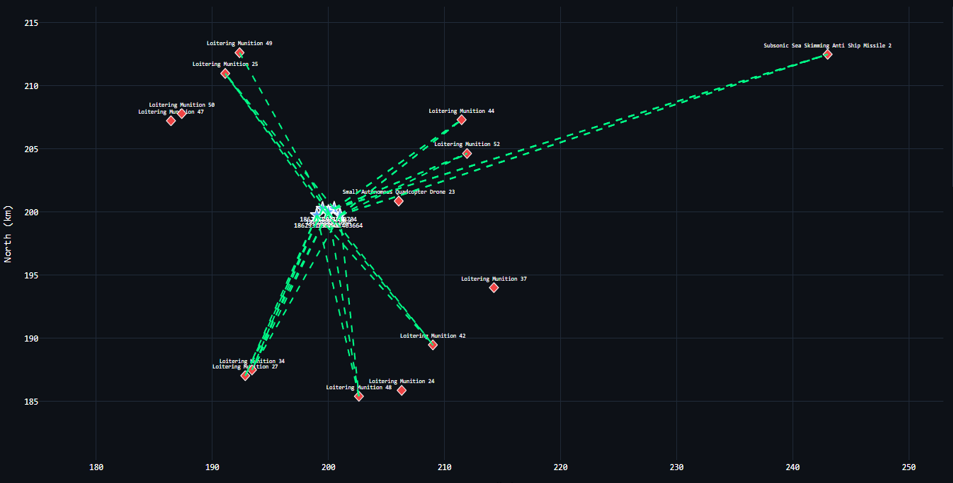
Cyre allocating task group assets against a mixed raid of loitering munitions and a subsonic sea-skimming anti-ship missile.
The predictive element sits inside that valuation. A threat’s urgency reflects how soon it could reach a protected asset and how much that asset is worth, feasibility accounts for whether an intercept can actually be achieved in time, and holding fire is treated as a real option, since the probability of a kill will often improve as a threat closes. Each platform’s plan is also checked against the time it genuinely has before its next planning cycle, so what comes out is executable rather than only optimal. Because the method is decentralised, it tends to degrade gracefully rather than fail outright, and platforms are able to join or leave part-way through an engagement.
The predictive nature of engagement solution generation also leads to a resilient capability as comms networks degrade in contested environments. Ships can plan their own optimal engagements around predicted actions of the rest of the fleet without any communication. This is possible because as scoring of potential engagements is self-consistent across the task group for the same mission context, so performant distributed optimisation can occur without the need for explicit sharing of plans.
Demonstrated Performance
8 vessels vs 250+ threats
Simulated fleet against a saturating raid to stress test performance
6 vessels vs ~80 threats
Tested in the MISC against representative threat profiles
< 1 second decision time
Force-wide allocation decision cycle delivers explainable engagement plans
Enabling the Hybrid Navy
A Hybrid Navy brings more platforms carrying sensors and effectors, which is a genuine gain in mass, but it also brings increased variety. Crewed warships, uncrewed surface vessels and autonomous air systems all arrive with different combat systems, different endurance, and different amounts of decision authority on board. Cyre suits that kind of force particularly well, for a few reasons.
– Because each platform reasons over whatever capability it happens to hold, Cyre can adapt to whether that platform is crewed or uncrewed, or which combat systems it contains. Variety becomes something the force can accommodate rather than something that has to be engineered around.
– Dynamic group membership as an engagement unfolds. A platform lost to attrition, running short of endurance, or cut off by comms denial simply stops contributing, and the remaining force settles on a new plan around its absence without anyone needing to intervene.
– Attritable platforms only add magazine depth in practice if allocation can actually draw on them in a coordinated way. Cyre is the layer that allows a loose collection of platforms to behave more like a single magazine across the integrated force.
Playing by the Rules
Rules of Engagement and operational restrictions are built into Cyre as constraints on the optimisation itself. Pairings that would breach them, such as a shot crossing an ally’s location, are discarded as candidates are generated, so they never become available to be selected at all. Assignments are compliant by construction rather than screened for compliance once they have already been produced. Command authority sits where it always has: Cyre allocates within the boundaries it is given, and it does not set them.
Engineered for Explanation
System assurance and operator trust are hard to achieve if system behaviour is opaque and unpredictable. The core of Cyre is specifically designed to be explainable and avoids technologies that result in black boxes. Every assignment is the outcome of an explicit valuation, so the reasons behind it remain recoverable afterwards: the urgency of the threat and the asset it was closing on, the kill probability on offer, the cost of the round expended, and the alternatives that were considered and scored lower. That comes from the structure of the method rather than from an interpretation layer sitting on top of it, and we have found it makes conversations about trust, assurance and post-engagement analysis considerably easier.
Intuitive Outcomes
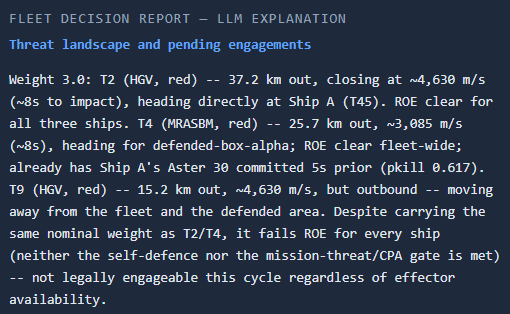
We are actively exploring the safe integration of large language models (LLMs) to produce summaries of the full Cyre output in intuitive formats. This approach safely integrates black box AI models to digest and explain the complex deterministic decisions, reducing the burden on human operators to maintain situational awareness of the full TEWA process.
This could also yield significant benefit in operator training or after action reviews, which is highly beneficial in continuing to build on the critical trust and understanding in new autonomous systems.