Transforming the UK from an AI Follower into an AI Leader
The current trajectory for AI in Defence and Security, as well as more broadly, feels locked-in: more data! More data centres! More foundation models! But the underground counter narrative is starting to loom increasingly more ominously. AI is eating itself causing bizarre behaviours, circular investment deals between the big players are now being unpicked by nervous investors, and the limitations of LLMs are starting to bubble to the surface as capital returns seem to feel like a mirage in the hot desert sun.
It is becoming increasingly apparent that these two narratives are set to do battle and will define what the future of AI really looks like.
But let's take a step back, amid the questioning of why the UK fails to create unicorns and drive the pace of the AI sector, I think there is value in assessing whether we are asking the right questions, or just the questions we think we should ask. Should the focus be on investment in sovereign UK LLMs? A boost in funding to catch up with the frontier labs? I believe that ship has sailed, both from a timing and a capability perspective. We should be looking to build the future, not run headlong into a potential technical dead end just as the market leaders change course. This is a wasteful use of our highly capable, but limited resources.
The UK is trying to position itself as an AI assurance powerhouse, so why not focus on a coherent strategy with assurance and resilient technology at its heart? Fundamentally, technologies designed to function in a regulated environment require a deep understanding of how they will operate across their operational design domain. In the current technical and investment frenzy it feels like we've lost the desire to really know what we're building at a deep level.
The UK has a long history of invention, ingenuity and world class engineering. With a coherent steer, the talent that we have can be pivoted to focus on AI that delivers genuine value to both society and UK PLC.
Abstraction and Unsustainable Resource Requirements.
Many of AI's breakthrough successes in recent years, particularly in the eyes of the public, are driven by deep learning. So much discourse and promise of improvements is underpinned by a need for more data and more compute, an insatiable quest for precious resource. While deep learning is undoubtedly a key tool in the data scientist's armoury, I believe that we need to put more focus on understanding how models deliver their intended functions, and the resource requirements for both training and inference. The business model for serving adverts may be able to sustain current and growing resource consumption, and black box solutions, but many critical problems cannot.
In some ways I would argue this mirrors the consequences of increasing abstraction in programming languages. Coding is more accessible but I would wager that vast quantities of Python is written without any understanding of how the computer executing the code actually works. A lack of software engineering, an undervalued skill at the best of times. An inefficient use of computational resources mitigated by Moore's Law and the bargain price of silicon. Assembly code, or the way compilers work, are mysteries in the eyes of most data scientists and software engineers.
This abstraction helps build software faster, but we don't accept this lack of understanding where the function the software is fulfilling really matters. The same applies for black box AI techniques. However, we've trained a generation of AI developers who can be blinkered by the shiny lights of deep learning, where the training algorithm, a lake of data and cloud infrastructure will result in a functioning model. Until the use cases really matter, or the realities of deployment don't fit the nice, clean environment it desires, then the house of cards collapses. We need to bring the focus back to creating engineers with the tools and experience to solve the key challenges that really matter and invent a better future for us all.
Choosing our battles in a time of hard choices.
“In truth, we’re going broke for talent before we go broke for money…” - Lt. Gen. Sir Tom Copinger-Symes, Deputy Commander of Cyber and Special Operations Command.
The above is an insightful quote that gets to the crux of some of the problems we face. The UK has a proud history of innovation and invention, but this is a trait we risk losing if we continue to try to play catch up with the US and Chinese giants and their foundation models.
Our resources will never match theirs, that's economic reality. We could invest in building data centre after data centre, throwing away last generation GPUs at an increasing rate and demanding small modular reactors to power the infrastructure. But what if these investments weren't necessary for the next phase of AI? What if we focussed a fraction of that investment in leading the way in more robust and sustainable paradigms? The UK is a resource constrained nation, let's build our AI to be the same.
If we have to choose our future path, why would we not focus on solving the problems that really matter, the types of challenges where we need to assure technology? We can act on the strategic intent to be a world leader in AI assurance and double down by also leading the world in developing assurable technologies. As a long-standing democracy we have a system that seeks to balance accessing the benefits of new technology with protection from a range of potential harms through regulation and policy. Ethics and strong governance are critical where the outcomes really matter, but this is also where the highest societal value can be obtained.
A call to arms.
Let's step away from the hype train and unsustainable investments in AI slop and focus on what drives society forward. The UK has phenomenal skills, talent and ingenuity, more than sufficient to set the standard for the future of AI and the societal benefit it can bring, we just have to harness and focus the talent and resources we have access to.
To help drive this we need imagination and foresight from those who shape and drive AI investment. Define the benefits and desirable properties that we need from the next generation of AI and back it up with meaningful, well deployed investment. Academia and industry are perfectly capable of refining that north star into research and development directions.
At Origami Labs we have a fantastic team who thrive on solving fiendishly difficult but critical problems for our customers. Diverse perspectives, free thinking and the confidence to buck technical trends lead us to approaches that are operational by design and deliver enormous value for our customers and wider society. We aren't the only people in the country capable of this, a clear demand signal backed up by investment would cohere and direct the talent in the right direction. Until then, we will continue to play our part and focus on the use cases that really matter.
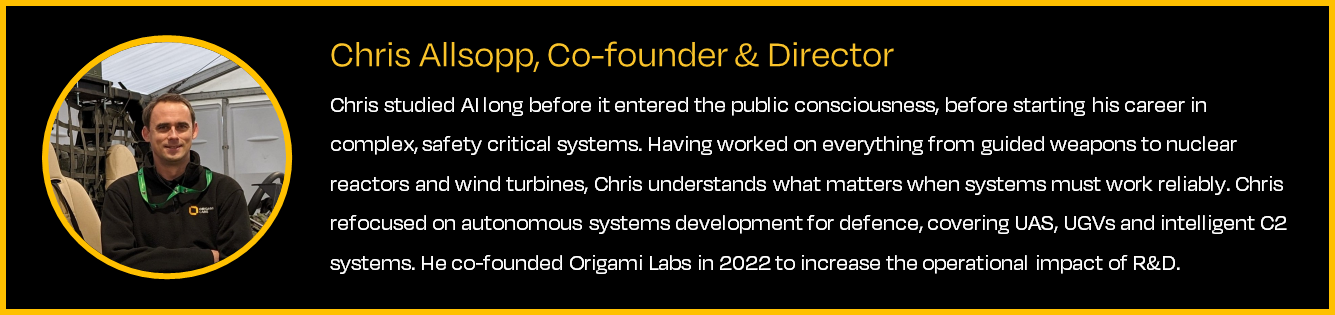
-- Chris Allsopp.